
Recording Parliament
At the end of July, I was invited to speak to the 25th anniversary gathering of the British-Irish Parliamentary Reporting Association. It’s a unique body which brings together all the people who make sure that we can read every single word spoken in all the parliaments of the British Isles – Westminster, Scotland, Wales, Northern Ireland, Ireland, the Isle of Man, Guernsey, Jersey and Alderney.
I began my talk by telling them about my earliest memory of sitting in the visitors’ gallery of the House of Commons with my father was when I was about eight. I gazed down at the benches below, and my eye was caught by an old man sitting just below the gangway on the Government side wearing a black jacket and pin-striped trousers.
What I noticed was that his legs were swinging because they didn’t quite touch the ground. I turned and said “Dad, who’s that?” and my father replied “That Hilary, is Winston Churchill”. I didn’t understand at that age what an extraordinary political career Churchill had had, having first been elected to the House of Commons in 1900. And during that career, he made many famous speeches, especially when he became Prime Minister in the Second World War.
We know everything that has been said in Parliament because of the diligence and professionalism of the Hansard reporters. When you think about it, turning a speech, which may include hesitation and “ums” and “eers” into a cogent piece of text is quite a skill in itself.
Scribes – as people who write things down used to be called – have occupied a notable place throughout history, although one unnamed English scribe in the 10th century described the job as follows: “Because one who does not know how to write thinks it is no labour, I will describe it for you if you want to know how great is the burden of writing. It mists the eyes, it curves the back, it breaks the belly and the ribs, it fills the kidneys with pain and the body with all kinds of suffering…. For as the last port is sweet to the sailor, so is the last line to the scribe.”
You can almost feel the pain in what he wrote!
The essence of the job has not changed, but the way reporting is done has, of course, evolved over time with the advent of radio and then television and voice recognition software.
But what we these days take for granted – the ability to read exactly what our Members of Parliament have said in the House of Commons – wasn’t always thus.
Whenever I take visitors around the House of Commons, I always stop at a painting just before you go into Central Lobby. I’ve always known it as “the Bible in the Fields” and my grandmother had a print of it above her fireplace.
It depicts a group of people in a field. In the centre of the painting is a man dressed in black with a book on his knees, surrounded by noblemen and farmers, and I always ask my visitors to describe what is going on.
Some of them notice that the woman in a pink dress is looking not at the man with the book, but in the opposite direction, as is the man on the left. They will often say “she looks anxious” and I reply “well she is, and the man on the left is the lookout”. Why? Because what they were doing was illegal at that time. They were reading the Bible.
And why was it illegal to do so in England in the 15th century? Because those who had power – the bishops – did not want those who did not have power – ie ordinary people – to be able to read what the Bible said for themselves, for fear that they might dispute the interpretation put on it by those in authority.
A reminder that words, arguments, ideas and information are all about power, and that is why the existence of a written record in all of our parliaments and assemblies is so important because it enables all of us to read what has been said.
Some of those words are memorably recorded in another painting.
It depicts the moment on the 4th of January 1642 when King Charles I forced his way into the Commons chamber hoping to arrest five MPs – only to discover that they had flown. When he demanded to know where they were, the then Speaker – William Lenthall – famously replied:
“May it please Your Majesty, I have neither eyes to see nor tongue to speak in this place but as this House is pleased to direct me whose servant I am here.”
This must have been an electrifying moment. The Speaker of the House defying the Monarch by explicitly asserting that his loyalty was to Parliament and not to the King.
Charles I withdrew, the Civil War broke out the following August and the rest is history.
And, of course, we remember that moment at every State Opening of Parliament when Black Road has the doors shut in his or her face and has to knock three times in order to gain entry to our chamber. A reminder all these years later that the Monarch’s representative comes into the House of Commons because we let them in and not because he thinks he has a right to be there.
If you go back to the 18th century, the Speaker urged MPs to find a way to stop the publication of unofficial reports of parliamentary business which were becoming increasingly popular. After a short debate, the House resolved that it was “a notorious breach of privilege of this House for any news-writer in letters or other papers to give theirin any account of the doings or other proceedings of this House, or any committee thereof, as well during the recess as the sitting of Parliament, and this House will proceed with the utmost severity against such offenders”. It was no idle threat, for offenders were fined and they were imprisoned.
A battle ensued, and it was eventually won in 1909 when Hansard became the Official Report.
Why should this matter so much?
Because words – once carved in ‘stone’ – become part of an invaluable historical record of what we said, and why we said it, and how we voted and what the consequences were. And in an age of fake news and amoral algorithms, and lies and distortions, the parliamentary record – Hansard – stands as an unimpeachable source of the truth. The spoken word faithfully recorded for eternity.
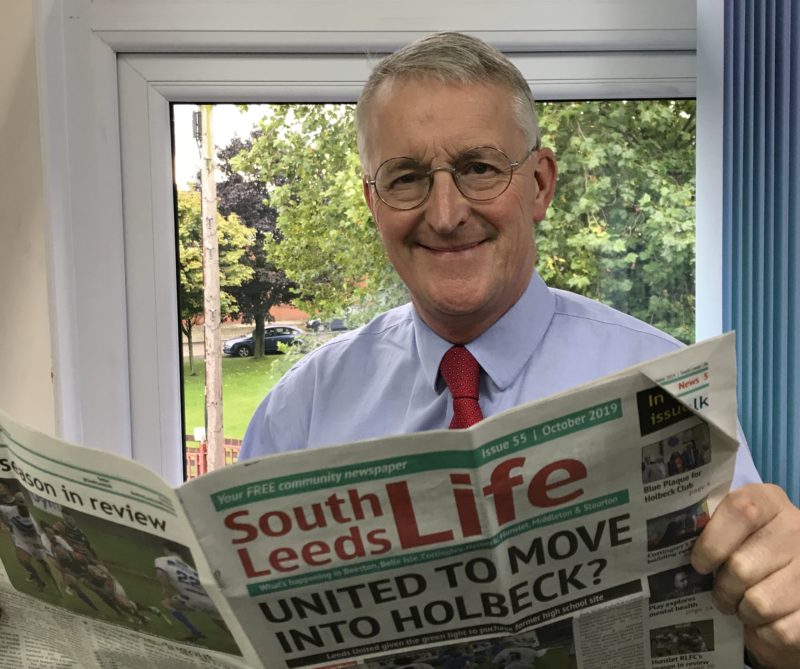
First published in the September 2026 edition of South Leeds Life, available online here https://southleedslife.com/mps-notebook-recording-parliament/